
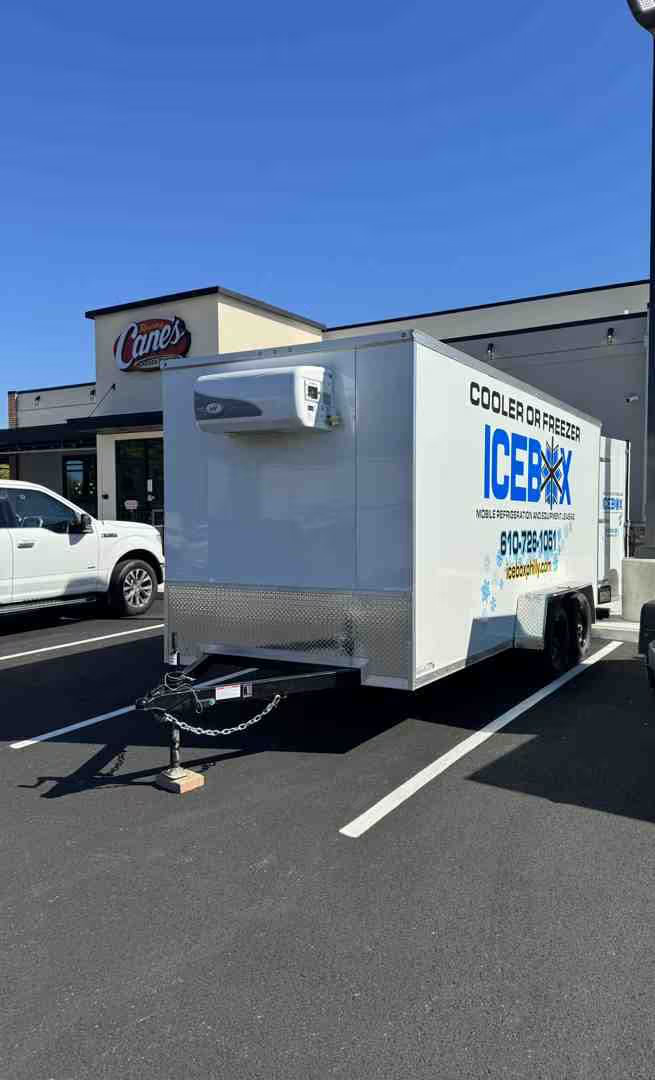
When Your Walk-In Cooler Fails, Every Minute Costs You Money
If you need an emergency walk-in cooler solution right now, here's what to do immediately:
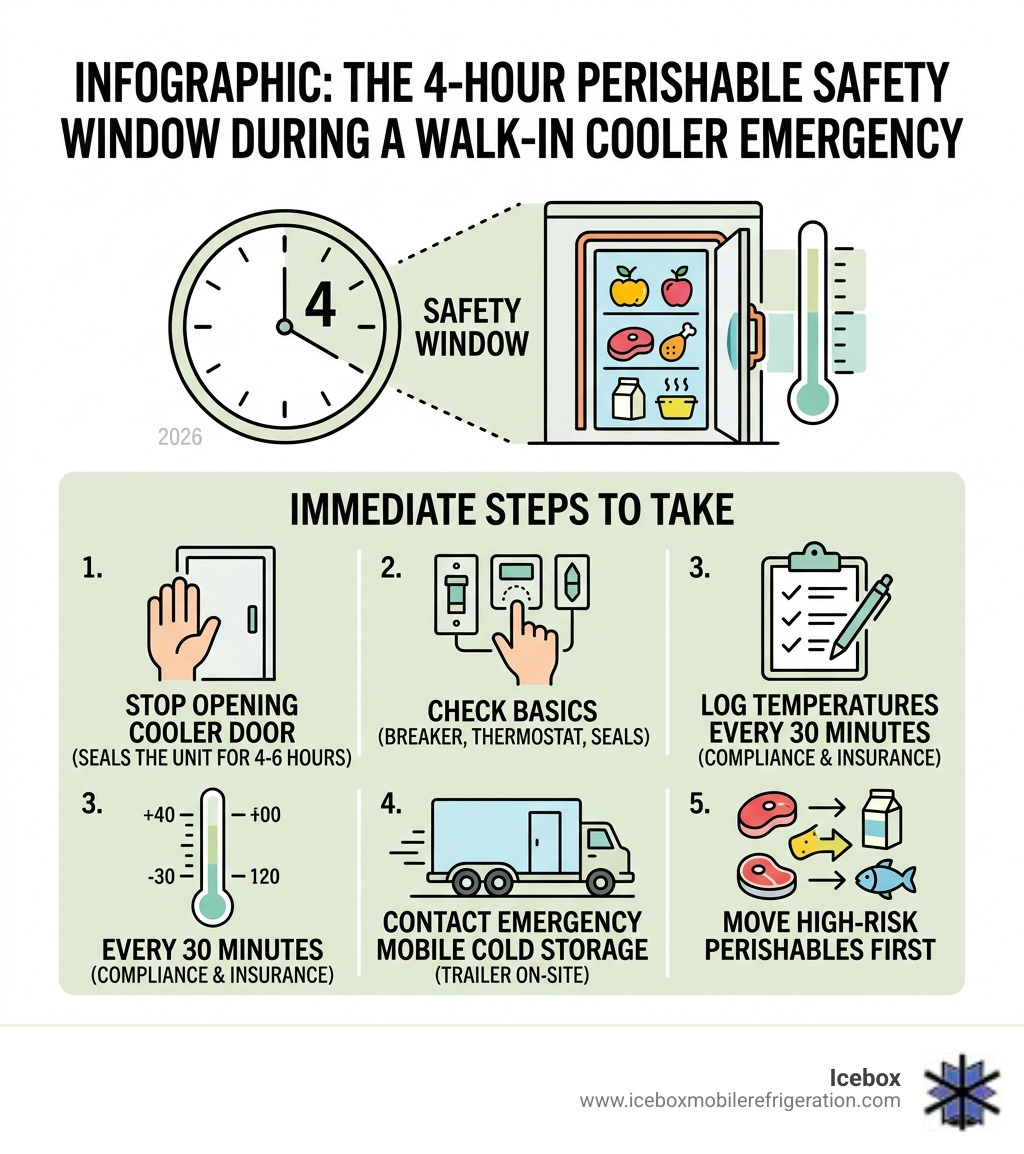
- Stop opening the cooler door — a sealed unit can hold safe temperatures for 4 to 6 hours
- Check the basics — circuit breaker, thermostat settings, and door seals
- Start logging temperatures every 30 minutes for health code compliance and insurance
- Contact an emergency mobile cold storage provider to get a refrigerated trailer delivered on-site while repairs are arranged
- Move highest-risk perishables first — proteins, dairy, and seafood spoil fastest
Picture this: it's 6 AM and your kitchen manager calls in a panic. Your walk-in cooler isn't running. You've got thousands of dollars in perishable inventory warming up by the minute — and service starts in a few hours.
This isn't a rare scenario. A typical walk-in cooler failure can result in $20,000 to $40,000 in total losses when you factor in spoiled inventory, lost sales, and potential health code violations. A single 60-minute outage alone can cost a food service operation up to $5,000.
The hard truth? Waiting for a repair technician isn't always fast enough. Common issues like compressor failures can take 3 to 7 days to fully resolve — far longer than your inventory can safely wait.
That's where an on-site mobile cooler trailer changes everything. Instead of watching your profits melt, you get a refrigerated trailer delivered directly to your location, up and running before your inventory hits the danger zone.
This guide walks you through exactly what to do — from the first moment your cooler fails, to protecting your stock, staying compliant, and getting back to business fast.
Learn more about emergency walk-in cooler:
Critical Response Strategies for an Emergency Walk-In Cooler Breakdown
When the humming stops, the clock starts. In the refrigeration world, silence is definitely not golden—it’s expensive. As of April 2026, the costs of food waste and health department fines have only climbed, making a proactive response more critical than ever. We have seen countless businesses in cities like Charlotte, NC, and Miami, FL, saved by a quick pivot from "panic mode" to "protection mode."
The first few minutes after discovering a failure are the most important. Before you start hauling boxes of expensive ribeye to your neighbor’s freezer, take a deep breath and follow a structured response strategy.
Step 1: Rule Out the Simple Fixes
It sounds obvious, but you’d be surprised how often an emergency walk-in cooler crisis is actually just a tripped circuit breaker or a bumped thermostat.
- Check the Power: Is the light on? Is the display active? If not, check your panel.
- Thermostat Settings: Did someone accidentally reset the target temperature during the night shift?
- Evaporator Coils: Are they iced over? If you see a block of ice, the unit might just need a defrost cycle, though this often points to a deeper issue like a faulty seal.
Step 2: The "No-Go" Zone
The most effective tool you have in the first hour is the door handle—specifically, not using it. Every time that heavy door swings open, you lose precious degrees of cold air. A well-insulated, sealed walk-in can maintain safe temperatures (below 41°F) for up to six hours if left undisturbed.
Step 3: Repair vs. Rental — The Reality Check
Most business owners' first instinct is to call a repair technician. While you certainly need one, relying on them to save your inventory is a gamble. In high-demand areas like Philadelphia, PA, or Detroit, MI, emergency technicians are often stretched thin. Even if they arrive within two hours, they might not have the specific compressor or fan motor needed for your unit.
| Factor | Standard Emergency Repair | Immediate Trailer Rental |
|---|---|---|
| Response Time | 2–6 hours for arrival | Rapid dispatch (often same-day) |
| Resolution Time | 3–7 days (if parts are backordered) | Immediate (ready to use upon delivery) |
| Cost Risk | $200–$500/hr + parts | Fixed rental fee |
| Inventory Safety | High risk of spoilage during wait | 100% protection once loaded |
| Business Continuity | Limited menu/closure | Full operations maintained |
For a more detailed look at managing these crises, see this Scientific research on handling cooler failures efficiently.
Immediate Inventory Protection via Emergency Walk-In Cooler Trailers
When the internal temperature of your cooler hits 40°F, you have entered the "Danger Zone." According to USDA and health department standards, perishable food must be kept at 41°F or below. Once it climbs above that threshold for more than two hours, bacteria multiply rapidly, and you are legally required to discard the product.
This is where an emergency walk-in cooler trailer becomes your best friend. Instead of trying to find space in overstuffed reach-ins, we bring the cold storage to your parking lot.
The Rapid Relocation List
When the trailer arrives, don't just throw things in randomly. Efficiency saves product. Use this priority list to move items into your emergency refrigeration rental:
- Raw Proteins: Seafood, poultry, and beef are the most sensitive and expensive.
- Dairy and Eggs: Milk, cream, and soft cheeses spoil quickly and can carry high bacterial loads.
- Prepared Foods: Sauces, soups, and prepped ingredients that have already been handled.
- Fresh Produce: While hardy, leafy greens and berries will wilt and lose value within hours of a temperature spike.
Our mobile cooler trailers are designed for ground-level access, meaning your staff doesn't have to navigate steep ramps or lift heavy crates into the back of a high-clearance truck. This speed of transfer is vital when you are fighting the clock.
Warning Signs of an Impending Emergency Walk-In Cooler Failure
The best emergency walk-in cooler is the one you see coming. While some failures are sudden (like a power surge blowing a control board), most units give you "hints" that they are struggling weeks before they finally quit.
If you operate a business in Pittsburgh, PA, or Nashville, TN, you know that extreme weather can put extra strain on your cooling systems. Keep an ear and an eye out for these red flags:
- Temperature Fluctuations: If your digital log shows the temperature bouncing between 34°F and 42°F throughout the day, your compressor is likely cycling too often or struggling to keep up.
- Unusual Motor Noises: Grinding, squealing, or heavy vibration from the condensing unit are the screams of a motor on its last legs.
- Frost and Ice Accumulation: Seeing "snow" on your evaporator coils or ice on the floor? This usually means moisture is getting in (bad seals) or the defrost timer is failing.
- Moisture and Pooling Water: Water on the floor often points to a clogged drain line, which can lead to ice buildup and eventual system shutdown.
- Door Seal Integrity: If you can slide a dollar bill through the door seal when it’s closed, you’re losing cold air and forcing the motor to work double-time.
For more technical indicators, check out this Scientific research on emergency freezer repair signs. Catching these signs early allows you to schedule a rental before the total breakdown occurs, turning a potential disaster into a managed maintenance event.
Advantages of 110-Volt Mobile Freezer Trailers
In the past, if you needed a temporary emergency walk-in cooler, you had to deal with massive diesel-powered "reefer" trucks. They were loud, they smelled like a highway, and they required constant refueling.
We’ve changed that. Our specialized fleet of mobile trailers utilizes 110-volt technology, which offers several game-changing advantages for small and medium-sized businesses:
- Standard Electrical Hookup: You don't need a specialized 220V outlet or a massive generator. Our units plug into a standard 110V/20-amp circuit. This means you can plug it into almost any exterior outlet on your building.
- 0°F Temperature Stability: Whether you need a cooler (34°F-38°F) or a freezer (holding steady at 0°F), these units are precision-controlled. Note: For safety and equipment longevity, our freezer trailers are designed to maintain a rock-solid 0°F, but not below that range.
- Quiet Operation: If your restaurant is in a quiet neighborhood in Greenville, SC, or a historic district in Steubenville, OH, the last thing you want is a roaring diesel engine keeping the neighbors awake. Our electric units hum quietly.
- No Diesel Fumes: You can place these units right next to your kitchen door without worrying about exhaust fumes entering your prep area.
- Ground-Level Access: As mentioned, the low profile makes loading and unloading a breeze. No more "climbing the mountain" to get a crate of tomatoes.
For a deeper dive into why this technology is the industry standard for emergencies, read our 110v refrigeration unit complete guide.
Industry-Specific Mobile Cold Storage Applications
Every industry has different stakes when it comes to refrigeration. A restaurant might lose its dinner service, but a hospital might lose life-saving medications. We tailor our emergency walk-in cooler services to meet these specific needs across our East Coast service area.
Restaurants and Food Service
In the culinary world, inventory is cash. Whether it’s a high-end steakhouse in Augusta, GA, or a bustling café in Akron, OH, a cooler failure can shut down your kitchen. Mobile trailers allow you to keep your prep work and raw ingredients safe so you don't have to turn away customers or simplify your menu.
Hospitals and Medical Facilities
Medical cold storage is about more than just "keeping things cold"—it's about precision and compliance. Vaccines, blood samples, and certain medications must be kept within very tight temperature windows. Our trailers provide the reliability needed for emergency cold storage in clinical environments, ensuring that patient care isn't compromised by equipment failure.
Event Catering and Seasonal Overflow
Sometimes the "emergency" isn't a breakdown—it’s a success! If you’ve booked a massive wedding in Charleston, SC, or a corporate event in Cleveland, OH, your existing walk-in might not have the capacity. A mobile trailer provides that extra "breathing room" for prepped appetizers and chilled beverages.
Pharmaceutical and Lab Storage
Compliance is king in the pharma world. Our units help maintain the chain of custody for temperature-sensitive materials during facility upgrades or unexpected outages, keeping you in line with strict regulatory standards.
Documentation for Insurance and Health Compliance
If you want your insurance company to cut you a check for spoiled inventory or the cost of your emergency walk-in cooler rental, you need to be the "King of Documentation."
When a failure happens, don't just fix it—record it.
- The Temperature Log: From the moment you notice the failure, record the internal temperature every 30 minutes. This proves to the health department that you moved the food before it reached unsafe levels.
- The Spoilage Record: If some items did reach the danger zone, take photos of the product and the thermometer reading before discarding them. Create a detailed spreadsheet of the lost items and their wholesale value.
- The Incident Report: Document when the failure started, when the repair tech was called, and when the mobile trailer was delivered.
- Mitigation Efforts: Insurance companies are more likely to cover your claim if you can show you took active steps to "mitigate the loss"—which is exactly what renting a trailer does. It shows you acted to save $30,000 in inventory by spending a fraction of that on a rental.
Maintaining these records is a key part of professional emergency refrigeration services. It protects your brand’s reputation and your bottom line.
Conclusion: Reliable Emergency Cold Storage Solutions
At Icebox, we understand that a refrigeration failure isn't just a technical glitch—it’s a threat to your livelihood. We’ve spent years perfecting our 24-hour response system to ensure that businesses along the East Coast, from the snowy streets of Wheeling, WV, to the sunny shores of Fort Lauderdale, FL, never have to face a cooler crisis alone.
Our 110-volt mobile trailers are designed for the modern business: they are quiet, easy to set up, and incredibly reliable. By choosing a mobile on-site solution, you bypass the delays of part backorders and the high-stakes gamble of "waiting for the repairman."
Don't wait until the ice melts and the health inspector is at your door. Whether you are currently staring at a rising thermometer or just want to be prepared for the inevitable, we are here to help.
Ready to protect your inventory? Contact us today for a custom quote and see how fast we can get your business back to a rock-solid 34 degrees.
Choose the perfect rental option
Explore our wide range of trailer rentals and find the one that suits your needs
%20(2)-min.webp)
Discover New Blog Posts
Stay updated with our latest blog content.
_compressed.webp)

